
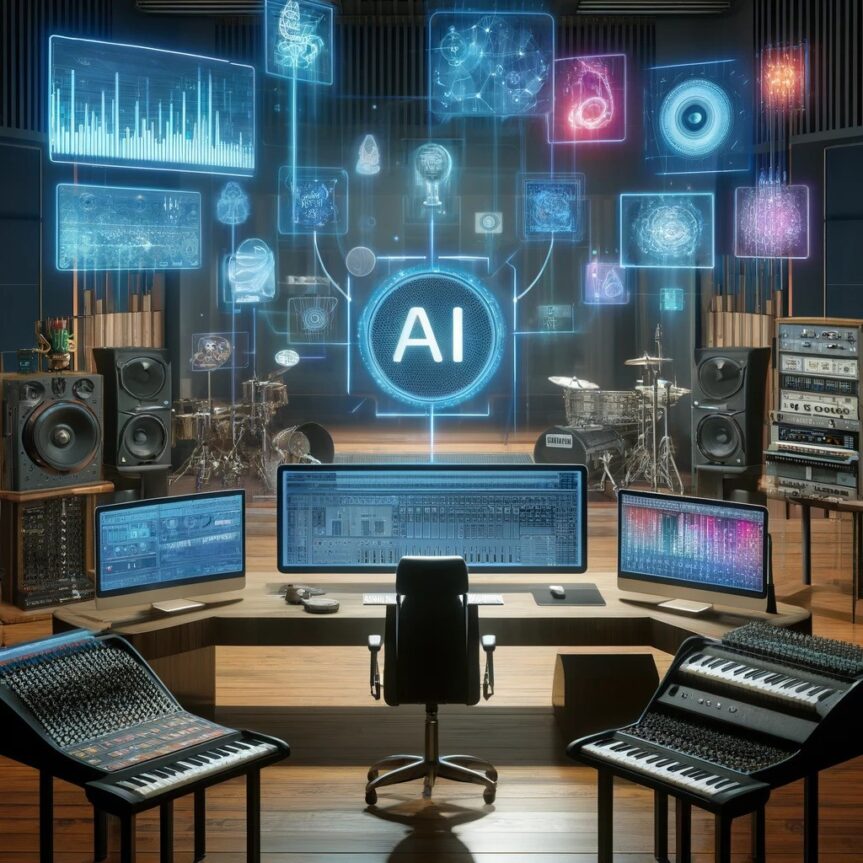
The Future of AI in the Music Industry: This piece provides a Sound Engineer’s point of view.
Category: Music Technology
Tags: AI in Music, Music Production, Sound Engineering, Music Technology, Future of Music
AI continues to disrupt the music industry by making production easier, augmenting creativity, and expanding frontiers. Over a decade as a sound engineer, I have seen how AI is affecting the field and how it will change our work in the future. In this blog post, I will reflect on some of the issues in music, the advantages of using AI, the ongoing challenges, and the future AI might provide.
AI’s data-handling prowess, particularly in recognizing patterns, is highly useful in music creation. New tools like OpenAI’s MuseNet can create new musical pieces in response to preset inputs, showing a lot of potential. AI mastering solutions like LANDR allow sound engineers to get mastered tracks ready for distribution with no effort.
Technological tools are becoming integral to our operations, helping streamline the manufacturing process. They save us time on routine tasks, allowing more time for creative endeavors. For instance, AI can listen to tens of thousands of songs to recommend new directions in music. This is valuable when we are trying to be creative or think outside the box.
Promoting Creativity in Musicians through AI
AI not only boosts efficiency but also enhances creativity. Tools like Jukedeck can create musical ideas for us, helping to overcome creative blocks. AI can generate ideas that might not have crossed our minds, expanding the possibilities of what we may design.For musicians and singers, AI can analyze lyrics to anticipate audience reactions and suggest modifications. It can even generate lyrics, making the music creation process more creative and engaging than relying on conventional methods.By leveraging AI, we can push the boundaries of music production, opening up new avenues for innovation and artistic expression. The integration of AI in music is not just about efficiency; it’s about enhancing the creative process and exploring new frontiers in music creation.

Challenges and Ethical Considerations of AI in the music Industry
However, there is a flip side to the whole process of integrating AI into the music industry. This is because there are real possible dangers of people losing their jobs as companies invest in automatic systems to do the work that people used to do. For many years, AI has been designed to perform routine operations; nevertheless, this development reduces the creativity of people living in the future society dominated by machines. Also, there are other ethical issues with reference to authorship and a uthorial intent of compositions created by AI. That is the question that arises as to who will own a piece of music generated by an artificial intelligence?Should the credit go to the creator of the AI, the user, or the AI itself?
Furthermore, relying on Artificial intelligence, produces homogeneity in the musical outputs. When everybody behaves the same, being driven by the same tools, one feels like the creativity that sets people apart gets lost. There is still a fine line between replacing people so that they don’t waste their efforts, and emasculating AI so that it does not stifle creative thinking. In this case, it is pivotal for AI and sound engineers to work hand in hand, without the application of AI diminishing the value of the sound engineers themselves.
The Possibilities of AI Applied to the Musical Business
Looking ahead, it is worthwhile to predict the future of AI in the music industry. Training machines will only improve with time. Soon, even better AI tools will emerge to augment creativity. Advancements in AI algorithms, which underpin virtual reality (VR) and augmented reality (AR) applications, will offer more detailed and engaging VR and AR content. This will lead to new opportunities for music creation and performance.In music collaboration, AI could allow artists to work together in parallel and asynchronously, without geographical restrictions. This would remove barriers that currently hinder artistic growth. AI could also forecast music trends and offer compositions that suit individual preferences.
In conclusion, AI is leading the music industry toward advancement and a digital makeover. A fresh set of challenges and opportunities is on the horizon. Ethical issues must be resolved to ensure AI assists creativity instead of replacing it. As we move into this technological age, the future of music looks brighter than ever.
AI has come for music, but there’s still a Great Big Sea between people and algorithms